Teach Your Cat Simple Tricks: Calm, Reward-Based Steps
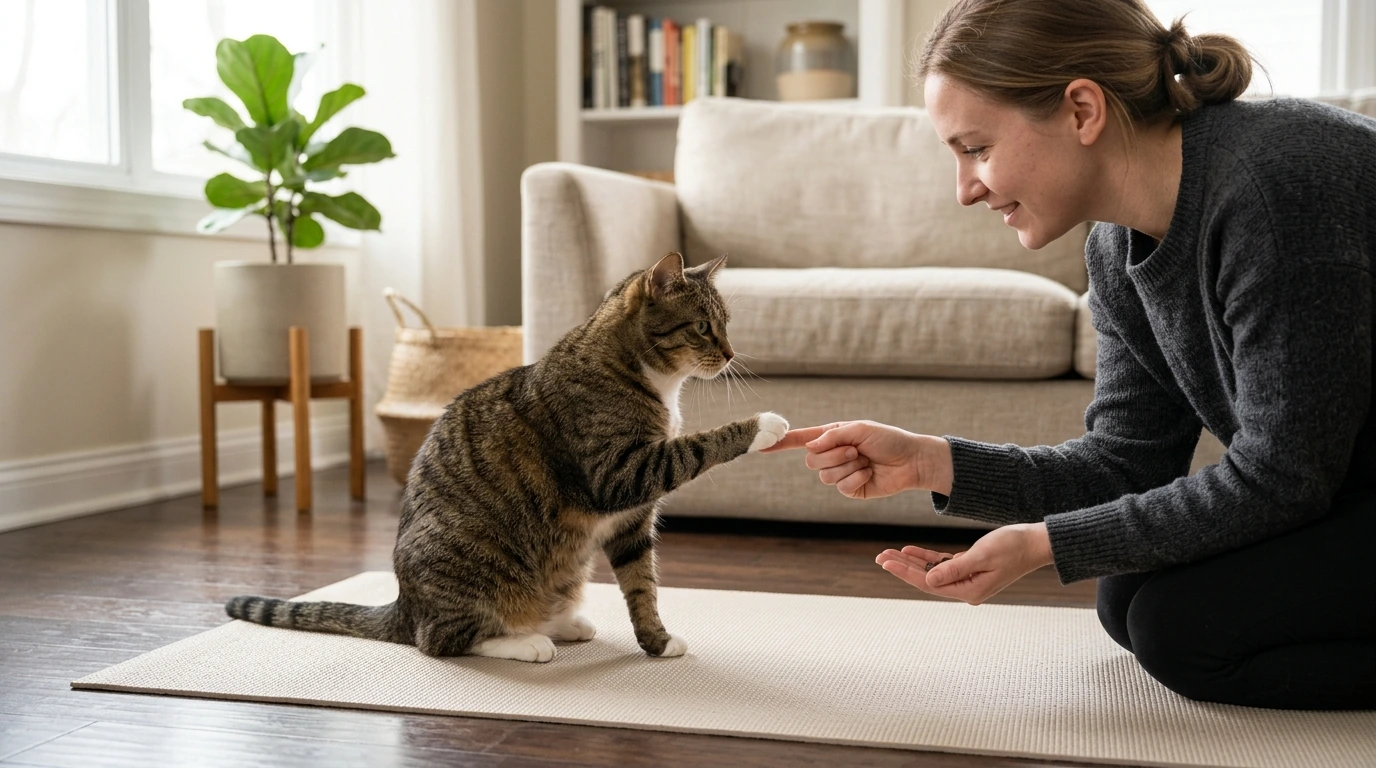
Teaching Your Cat Simple Tricks: A Calm, Reward-Based Plan That Actually Sticks
Cats learn fast when training feels like a game they control. Our goal isn’t to “make” your cat perform—it’s to shape tiny choices into repeatable cues using rewards, timing, and short sessions. With a low-stress routine, you can teach beginner tricks like sit, high five, come, and jump while protecting confidence, avoiding frustration, and keeping it genuinely fun for both of you.
Reward-based training is also the welfare-forward standard recommended by leading behavior organizations. If you’d like to read more about humane methods, see the American Veterinary Society of Animal Behavior (AVSAB) position statements and the RSPCA’s guidance on cat training and learning.
What makes cats learn (and what makes them quit)
Training success is less about “stubbornness” and more about setting up conditions where the right choice is easy and rewarding.
- Motivation first: Train right before a meal, or use truly high-value treats (soft, smelly, easy to chew).
- Keep it voluntary: If you see avoidance—tail flicking, ears back, turning away, walking off—end the session or make it easier.
- Reinforcement beats repetition: Reward the instant the behavior happens. Don’t push, grab, or position your cat with hands.
- One cue per behavior: Say the cue once, then wait. Repeating teaches your cat the first cue wasn’t important.
- Environment matters: Start in a quiet room with minimal distractions and a non-slip surface.
| Element | Best starting point | Why it helps |
|---|---|---|
| Session length | 1–3 minutes | Prevents boredom and keeps motivation high |
| Repetitions | 5–10 reps per trick | Enough practice without fatigue |
| Treat size | Pea-sized or smaller | More rewards without overfeeding |
| Reward timing | Within 1 second of the behavior | Builds a clear connection between action and reward |
| End-of-session cue | “All done” + a final treat | Signals a clean finish and reduces pestering |
Tools that make training easier (no fancy gear required)
- Treats: Choose small, soft pieces; rotate options so your cat stays interested.
- Marker signal: A clicker or a consistent word like “Yes!” to mark the exact moment your cat gets it right.
- Target tool: A fingertip, spoon, or target stick to guide movement without pushing or grabbing.
- Mat or perch: A stable “station” (small mat, cat tree platform) helps your cat start and reset predictably.
- Notes: A notebook or notes app to track cues, rewards, and success rate so you don’t accidentally change the rules mid-week.
One practical comfort tip: since sessions are short but frequent, you’ll be on the floor a lot. If you want a cozy layer for training time, our team keeps comfy options in stock like the Women’s Color-Blocking Letter Embroidery Oversized Sweatshirt.
A simple training sequence: lure → mark → reward → fade the lure
Step 1 — Lure
Use a treat to guide your cat into position. Example: move the treat from nose level up and slightly back to encourage a sit.
Step 2 — Mark
The instant the behavior happens (butt touches the floor, paw lifts, nose touches a target), mark with a click or “Yes!”
Step 3 — Reward
Deliver the treat right away. Then reset cleanly by tossing a treat a short distance so the next repetition starts fresh.
Step 4 — Add the cue
When your cat is reliably doing the behavior with the lure, say the cue a beat before the motion.
Step 5 — Fade the lure
Swap the treat lure for an empty-hand gesture. Mark first, then reward from your other hand or pocket.
Step 6 — Proof slowly
Change only one variable at a time: new room, longer distance, different person, or slightly more distraction.
Beginner tricks to teach first (with quick win steps)
Common training snags and easy fixes
Building a weekly routine that keeps skills reliable
A complete, step-by-step guide for faster progress
If you want a structured plan you can follow without guesswork, our team recommends Teaching Your Cat Simple Tricks: A Complete Guide to Teaching Cats Simple Tricks, Tips & Techniques. It lays out a clear sequence—foundation skills, cue building, troubleshooting, and trick progressions—so you always know what to practice next.
If your training sessions turn into longer play blocks, having “you” gear that can handle floor time can help you stay consistent—some customers pair training time with cozy basics like our Women’s Sheepskin Mules for quick on/off comfort around the house.
FAQ
How long does it take to teach a cat a simple trick?
Many cats learn the first version of a trick in a few days, but reliability typically takes a few weeks of short daily sessions. Faster progress comes from high-value rewards, clean timing, and ending before your cat gets bored.
Should a cat be trained with a clicker or a word marker?
Either works if you’re consistent and your timing is tight (about a second or less after the behavior). Clickers can be more precise, while a word like “Yes!” is convenient when your hands are full—pick one and stick with it.
What treats work best for cat training without overfeeding?
Use pea-sized soft treats, break larger treats into tiny crumbs, and consider using part of your cat’s daily kibble for easy behaviors. Keep a rough tally of total treats per day so training rewards don’t quietly become an extra meal.
















Leave a comment