Discipline Without Yelling: 10-Step Calm Parenting Script
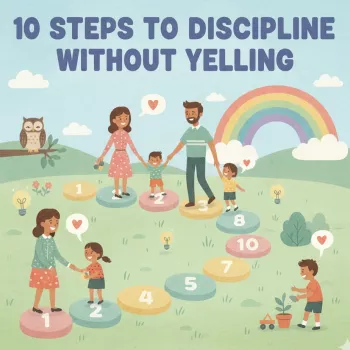
10 Steps to Discipline Without Yelling: A Calm, Effective Checklist for Real-Life Parenting Moments
Yelling usually shows up when everyone’s nervous system is overloaded—kids included. Calm discipline doesn’t mean “no boundaries.” It means clear limits, predictable follow-through, and a steady tone that helps your child learn what to do next. Our team built this plan as a simple, repeatable routine using a 10-step checklist you can keep on the fridge, in a diaper bag, or on your phone for the moments when your patience is thin and your child’s behavior is loud.
If you want a ready-to-print version you can grab quickly, we keep our 10 Steps to Discipline Without Yelling Checklist | Positive Parenting Guide to Calm & Effective Discipline in stock so you can use the same script every time—especially during transitions, sibling flare-ups, and bedtime.
Start with the goal: teach skills, not win the moment
When things get tense, it helps to decide what you’re actually teaching—because “stop it” isn’t a skill. A clear goal keeps your words short, your tone steadier, and your follow-through more consistent.
- Name the behavior goal in one sentence: “Safe hands,” “Inside voice,” “Toys stay on the floor,” or “Kind words.”
- Separate your child from the behavior: correct the action without labeling (“You’re having a hard time” instead of “You’re being bad”).
- Pick one limit to enforce right now: too many corrections at once often escalates everyone.
- Use short, concrete directions: tell your child what to do, not only what to stop doing (“Feet on the floor” beats “Don’t climb”).
The 10-step no-yelling flow (use it like a script)
Think of this like a calm “flow chart” you can follow even when you’re tired. You’re not trying to sound inspirational—you’re trying to be consistent.
- Pause for two breaths: slow the exhale to lower your intensity before you speak.
- Move closer: discipline works better at connection-distance than across the room.
- Get on their level: your eyes and voice soften when faces are near and calm.
- State the limit once: one sentence, neutral tone, no lecture.
- Validate briefly: “You wanted more time. It’s hard to stop.” Validation isn’t permission; it’s de-escalation.
- Offer a clear choice: two acceptable options you can live with (not an open negotiation).
- Follow through immediately: calm action beats repeated warnings.
- Repair and reconnect: a quick reset helps the lesson stick—“Try again” is powerful.
- Teach the replacement skill: show the exact words or action to use next time.
- Reset the environment: reduce triggers (lower the backpack hook, pre-pack snacks, set a timer) so the same conflict is less likely tomorrow.
Calm Discipline Quick Checklist (printable format)
| Moment | What to say (calm script) | What to do (follow-through) | What to teach (next time skill) |
|---|---|---|---|
| Hitting / rough play | “Safe hands. I won’t let you hit.” | Block the hit; move child a step away; pause play. | “Say: ‘Stop’ or ‘I need space.’ Practice once.” |
| Not listening / ignoring | “I need you to ____ now.” | Walk closer; guide gently; reduce distractions. | “Repeat the direction back to me.” |
| Tantrum / yelling | “You’re upset. I’m here. The limit is ____.” | Stay nearby; keep voice low; offer a calm-down spot. | “When you’re ready, ask for help with words.” |
| Sibling conflict | “I won’t let you hurt each other.” | Separate; give each child space; then take turns. | “Use: ‘Can I have a turn?’ / ‘Trade?’ / ‘Help!’” |
| Bedtime stalling | “Bedtime. Two choices: books then bed, or bed then books tomorrow.” | Keep routine moving; lights dim; fewer words. | “Use the bedtime checklist—one step at a time.” |
What “follow-through” looks like without harshness
Follow-through is where calm discipline becomes real. You don’t need threats or big punishments—you need a predictable next step that matches the behavior.
What to do when you feel the yell rising
For extra support on hard days, our team also likes “comfort anchors” that make it easier to stay steady—like something cozy you can throw on at the end of a long bedtime routine. If that’s useful for you, we keep the Women’s Color-Blocking Letter Embroidery Oversized Sweatshirt and Women’s Sheepskin Mules in stock as practical, comfort-forward options for at-home resets.
Make it easier tomorrow: set up your home for calmer discipline
If you want deeper background on positive discipline, you can also review guidance from the American Academy of Pediatrics, the CDC’s Essentials for Parenting, and the American Psychological Association on anger and regulation.
How to use the printable checklist in the moment (and not forget it exists)
A gentle reminder: calm discipline still counts as discipline
FAQ
What if my child laughs or ignores me when I stay calm?
Calm isn’t optional—it’s the tone, not the boundary. Move closer, use fewer words, state the limit once, and follow through with action immediately so your child learns you mean what you say without needing to sound “bigger.”
How do I discipline without yelling when I’m already overstimulated?
Do two slow breaths, press your feet into the floor, and use one short script line, then switch to action instead of talking. If a yell happens, repair quickly and return to the same checklist steps so your child still gets a consistent pattern.
Are time-outs necessary for calm discipline?
No—many families use brief calm-down breaks, separation for safety, or a “pause spot” without shame. The key is treating the pause as regulation and reset, then teaching the replacement skill your child can use next time.














Leave a comment