Break the Comparison Spiral: Fast Resets That Work

Stop the Comparison Spiral: Small Shifts That Break the Loop and Bring You Back to You
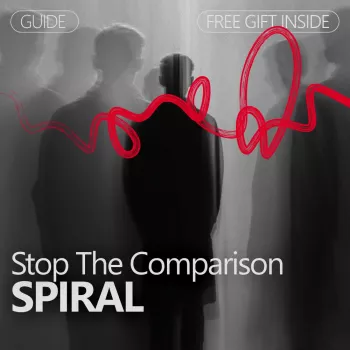
Comparison can start as “just a quick scroll” and end as a full-body slump—motivation drops, focus fractures, and confidence feels conditional. Our team built Stop the Comparison Spiral – A Practical Guide on how to avoid negative comparison traps, Build Confidence, and Reclaim Your Focus for that exact moment: when your mind keeps measuring, ranking, and rewriting your worth. You don’t need a perfect mindset—just a few repeatable moves that help you notice faster, recover faster, and choose on purpose.
What the comparison spiral looks like (before it steals your whole day)
The spiral is rarely loud at first. It usually begins as a “check” that turns into a search for proof that others are ahead. Then your brain cherry-picks someone else’s best moments and compares them to your behind-the-scenes. That mental tax is real: energy shifts from creating and living to monitoring and judging.
Afterward, you might feel irritability, shame, numbness, or the urge to overwork to “catch up.” The hidden pattern is that it tends to show up during stress, fatigue, transition seasons, or when you don’t have clarity about your next step.
Quick map: Trigger → Thought → Trap → Reset
| Trigger | Automatic thought | Comparison trap | Fast reset to try |
|---|---|---|---|
| Scrolling social feeds | “Everyone has it together except me.” | Highlight-reel bias | Name 3 unseen costs of that highlight (time, support, edits) and return to one task in front of you. |
| Seeing a peer’s milestone | “I’m behind.” | Single-metric worth | Switch metrics: progress, consistency, learning, recovery—pick one that matches your real season. |
| Work performance pressure | “If I’m not the best, I’m nothing.” | All-or-nothing ranking | Define “good enough for today” and do the next smallest step in 10 minutes. |
| Body/appearance comparisons | “I should look like that.” | Unfair baseline | Shift to function: list 3 ways your body supports your day; choose one supportive habit (water, walk, stretch). |
| Feeling excluded | “No one chooses me.” | Mind-reading | Reach out to one safe person with a simple plan: coffee, call, or a short check-in. |
Why comparison hits harder online (and why that’s not a personal flaw)
Online spaces amplify extremes. Algorithms reward intensity, so the most polished, dramatic, or exceptional content rises to the top. Constant access creates false frequency—because the feed is always available, it can feel like “everyone” is thriving all the time.
What doesn’t show up on the screen is context: support systems, resources, health, timing, setbacks, and sheer effort. Your brain reads social signals quickly; without boundaries, it treats your feed like a scoreboard. A healthier goal isn’t “never compare”—it’s “notice faster, recover faster, and choose on purpose.” For a broader overview of how social media can affect well-being, you can read the American Psychological Association’s guidance here: https://www.apa.org/topics/social-media-internet/health.
The core skill: turning comparison into information (not a verdict)
Comparison turns toxic when it becomes a verdict about your worth. Start by catching verdict language: “never,” “always,” “should,” “behind,” “not enough.” Those words create urgency and shame, not clarity.
Fast resets for the moment you feel the spiral start
If you want a structured set of these tools in one place—especially for the “I know better but I still do it” moments—our team put them into Stop the Comparison Spiral so you can follow a simple sequence instead of trying to think your way out mid-spiral.
Confidence that doesn’t depend on being ahead
A simple weekly routine to reclaim focus
- Pick one north star: a single priority that makes everything else feel simpler.
- Schedule intentional input: decide when you scroll, who you follow, and what actually supports your goals.
- Create one offline anchor: an activity that returns attention to your life. If your best reset is “get outside,” our team loves having gear that makes it easier to follow through—like the Automatic Quick-Open Camping Tent with Sun Protection & Spacious Cabin for an uncomplicated day outdoors.
- Do a Sunday reset: note what triggered comparison, what helped, and one boundary to keep next week.
Make it repeatable, not perfect. Even small comfort cues can support the routine—pulling on something cozy like our Women’s Color-Blocking Letter Embroidery Oversized Sweatshirt can become a “start signal” for journaling, stretching, or your 10-minute focus funnel.
When to get extra support
A simple standard: if it’s interfering with sleep, work, relationships, or self-care, it’s worth addressing directly. For practical mental health basics and support pathways, the National Institute of Mental Health has helpful resources here: https://www.nimh.nih.gov/health/topics/caring-for-your-mental-health.
FAQ
How long does it take to stop comparing yourself to others?
Comparison is a habit, not a character trait, so change is usually measured in stages: days to notice your triggers, a couple of weeks to interrupt spirals faster, and ongoing practice to make your boundaries feel automatic. If you keep one weekly routine and a couple of fast resets, you’ll typically feel relief before you feel “cured.”
What if comparison motivates me sometimes—do I need to stop completely?
You don’t need to stop completely; the goal is to shift from verdict to information. A quick test: after you compare, do you feel clearer and energized with a next step, or smaller and scattered with self-judgment?
What’s the fastest way to break a comparison spiral in the moment?
Label it (“comparison spiral”), do a 30–60 second grounding reset (like 5-4-3-2-1), and take one 10-minute next step on a real task. Then add one boundary move—close the app or put the phone face down—so the loop can’t immediately restart.














Leave a comment